
Notification rules · NSW
Who tells the neighbours, how far out and how many days before. Updated for the statewide Community Participation Plan that started on 1 September 2026.
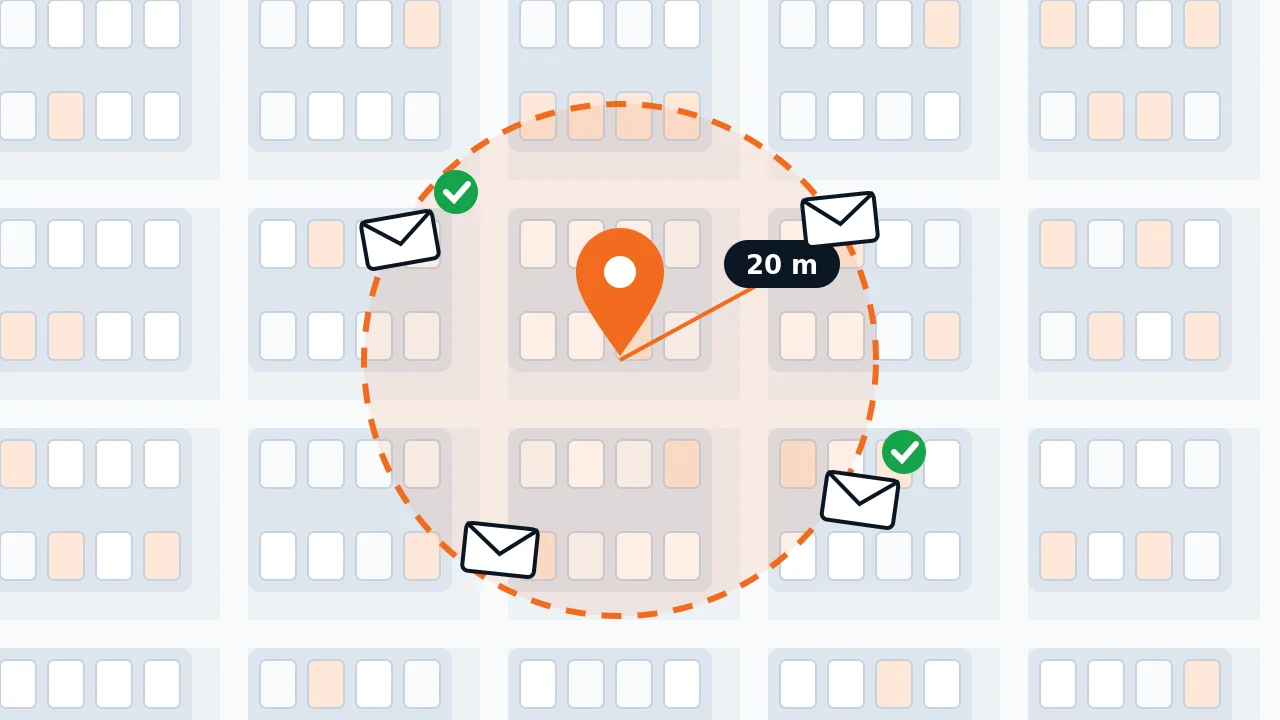
Quick answer: for a development application, council notifies the neighbours. For complying development (a CDC), you must tell every neighbour within 20 m of the lot boundary in writing at least 7 days before work starts in Sydney and other metropolitan areas, or 2 days in regional areas. Since 1 September 2026 one statewide plan sets the exhibition rules for every NSW council.
Working out dates? The notice period calculator counts the days for you, including business days and holidays.
Free template: CDC neighbour notice (NSW), ready to copy and print.
NSW used to have more than 100 council Community Participation Plans, each with its own distances and periods. From 1 September 2026 every council and planning authority must use one statewide Community Participation Plan.
Councils still decide how they notify (letters, emails or a site sign) through their own engagement strategies.
Source: Community participation plans, NSW Department of Planning, Housing and Infrastructure. Checked 7 October 2026.
Complying development is where the builder or owner carries the notification, not council.
| Before approval | In metropolitan areas the certifier or council tells neighbours within 20 m that a CDC has been applied for, 14 days before it can be approved |
|---|---|
| Before work starts | The applicant tells every neighbour within 20 m of the lot boundary, in writing. At least 7 days before work in metropolitan areas, 2 days in rural, regional and residential release areas |
| How | In person, in the letterbox or by post. Each dwelling in a dual occupancy or apartment building gets its own notice |
| Can neighbours object? | No. The notice is for information only |
A proposal from April 2026 would drop the pre-approval notice and make the 7 day pre-construction notice apply across NSW. At the time of checking it had not been confirmed as in force, so check with your certifier.
Source: What to tell your neighbours, NSW Planning Portal. Checked 7 October 2026.
Twenty metres from the boundary catches more homes than people expect: the houses either side, the ones behind, everyone across the road and every unit in a block that falls inside the line. A 50 m circle from the middle of a typical suburban block covers everyone within 20 m of its boundary. On a large or long block, set the circle wider so it reaches 20 m past the furthest corner.
Use our construction notice template for the wording, and keep a copy of the address list and the date you delivered. If a neighbour later says they were never told, that record is what you rely on.
Even when council handles the formal exhibition, many consents include a condition to tell neighbours before work starts, before demolition or before a road or footpath is occupied. Read your conditions of consent. If there is one, it will say who must be told and how many days ahead.
Plenty of builders send a courtesy letter on every job regardless. One notice a week before the slab pour or the crane saves a lot of phone calls.
What each council’s own document says. Most of these were written before the statewide plan, so they apply to DAs lodged before 1 September 2026. Each one links to the source so you can check the current version.
| Who sends letters | Council, to owners and occupiers around the site |
|---|---|
| Who gets one | Within 25 m for 14 day notifications, 50 m for 21 days, 75 m for 28 days. In strata buildings, the owners corporation and each unit owner |
| Notice period | 14 days for single dwellings, 21 days for flat buildings of 3 or more storeys |
The City says the statewide plan replaces its own plan from 1 September 2026, so these distances apply to DAs lodged before then.
Source: Community Engagement Strategy and Community Participation Plan 2025-2029. Checked 7 October 2026.
| Who sends letters | Council, by post |
|---|---|
| Who gets one | Owners and occupiers within 20 m (at least 10 properties) for houses, alterations, dual occupancies and demolition. 50 m for flat buildings and multi dwelling housing, 75 m for the largest proposals |
| Notice period | 14, 21 or 28 days depending on the type |
A sign also goes up at the site for the notification period. The radius is measured from every point of the site boundary.
Source: Inner West Council Community Engagement Strategy 2025-29. Checked 7 October 2026.
| Who sends letters | Council, by email or post |
|---|---|
| Who gets one | Owners and occupants within 40 m of each boundary of the site |
| Notice period | 14 days |
Internal and minor external alterations outside heritage areas go on the website only. Bigger proposals also get a site notice put up by Council.
Source: Randwick City Council Community Engagement Strategy (April 2025). Checked 7 October 2026.
| Who sends letters | Council |
|---|---|
| Who gets one | Adjoining owners and occupiers, and those directly across the road |
| Notice period | 14 days. 21 days for DAs decided by the Sydney North Planning Panel, 28 days for designated development |
A sign goes on the main frontage as well as the letters.
Source: Northern Beaches Community Participation Plan. Checked 7 October 2026.
| Who sends letters | Council |
|---|---|
| Who gets one | Owners or occupiers of land immediately next to the site, plus anyone else the assessing officer thinks may be affected |
| Notice period | 14 days for houses and dual occupancies, 21 days for new multi dwelling housing, 28 days for designated and integrated development |
Source: Waverley Community Participation Plan 2019 (Amendment 2). Checked 7 October 2026.
| Who sends letters | Council |
|---|---|
| Who gets one | New houses and dual occupancies: all adjoining land. Alterations and additions: adjoining land on either side. Larger proposals: 3 properties each side and 7 to the front and rear |
| Notice period | 14 days. At least 28 days for new flat buildings |
Source: Ku-ring-gai Community Engagement Strategy 2025. Checked 7 October 2026.
| Who sends letters | Council. The applicant must also display the A4 notice Council issues at the site |
|---|---|
| Who gets one | Owners sharing a boundary or directly across the road. Council can widen the area |
| Notice period | 14 days |
Source: Hornsby Shire Council Community Engagement Strategy (December 2024). Checked 7 October 2026.
| Who sends letters | Council |
|---|---|
| Who gets one | Adjoining properties: a common boundary, directly opposite, or across a pathway or driveway. Wider for some uses, such as 50 m for multi dwelling housing and 100 m in rural zones |
| Notice period | 14 days. 28 days for designated development |
Dwelling houses and alterations to existing houses were not notified under this plan.
Source: Liverpool Community Participation Plan 2025. Checked 7 October 2026.
| Who sends letters | Council |
|---|---|
| Who gets one | Adjoining owners and occupiers at least. The assessing officer can widen the area |
| Notice period | 14 days, which the officer can cut to 7 or extend |
Source: Penrith City Council Community Engagement Strategy 2024. Checked 7 October 2026.
| Who sends letters | Council |
|---|---|
| Who gets one | Owners of adjoining land, including land across a creek or road |
| Notice period | 14 days. 21 days for flat buildings, multi dwelling housing and subdivisions of 10 or more lots |
Houses that meet every standard were not notified. Houses that do not were notified for 14 days.
Source: Central Coast DCP 2022, Chapter 1.2 Notification of Development Proposals. Checked 7 October 2026.
| Who sends letters | Council |
|---|---|
| Who gets one | Neighbours (no distance given) |
| Notice period | 14 days |
From 1 September 2026 Council no longer sends neighbour letters for the excluded types, such as homes up to two storeys, alterations, pools, sheds, carports and demolition, unless the plans go over the height or floor space limits.
Source: Changes to Development Application Notification. Checked 7 October 2026.
| Who sends letters | Council |
|---|---|
| Who gets one | Neighbouring properties (no distance given) |
| Notice period | 14 days |
Council now follows the statewide plan: no neighbour letters for new houses and dual occupancies up to two storeys, secondary dwellings, alterations, pools, sheds, carports and demolition unless they break the height or floor space limits. Those DAs still show on the DA tracker.
Source: Changes to Development Application Notification Requirements. Checked 7 October 2026.
| Who sends letters | Council |
|---|---|
| Who gets one | Owners of adjoining or opposite land. In strata, the owners corporation and, at Council’s choice, owners and occupiers of the adjoining building |
| Notice period | 14 days for houses, additions and secondary dwellings. 7 days if plans are renotified |
Source: Cumberland Development Control Plan, Part A (April 2023). Checked 7 October 2026.
| Who sends letters | Council |
|---|---|
| Who gets one | Follows the statewide plan |
| Notice period | Follows the statewide plan |
Parramatta says its own notification table is superseded from 1 September 2026, and that it will not consider submissions on DAs the statewide plan does not require to be notified.
Source: Submissions on Development Applications. Checked 7 October 2026.
| Who sends letters | Council |
|---|---|
| Who gets one | Follows the statewide plan |
| Notice period | Follows the statewide plan |
Source: Sutherland Shire Council Community Engagement Strategy 2026-30. Checked 7 October 2026.
| Who sends letters | Council |
|---|---|
| Who gets one | Follows the statewide plan |
| Notice period | 14 days minimum where exhibition is needed |
All three now point to the statewide plan. Canterbury-Bankstown and Campbelltown host a copy of it on their own sites.
Source: Wollongong City Council: Notifications and Submissions. Checked 7 October 2026.
Pin the site, set the radius and get every letterbox inside it as a walk list, with a signed delivery record and printable notices when the job needs them. The count is free.