
Notification rules · QLD
In Queensland the applicant, not council, carries out public notification. Here is what that involves and how long it takes.
Quick answer: only impact assessable applications (and those with a variation request) are publicly notified in Queensland, and the applicant must do it. That means a letter to the owners of every adjoining lot, an A0 sign on the road frontage and a public notice, for at least 15 business days (30 with a variation request). Code assessable applications are not notified.
Working out dates? The notice period calculator counts the days for you, including business days and holidays.
| Who | The applicant |
|---|---|
| Letters | To the owners of all lots adjoining the premises |
| Sign | At least A0, weatherproof, at least 300 mm above the ground, on the road frontage and clearly visible from the road |
| Public notice | By the method in council’s confirmation notice, traditionally a local newspaper |
| How long | At least 15 business days after notice is given, 30 business days with a variation request. 20 December to 5 January does not count |
| Afterwards | Give council written notice of compliance within 10 business days after the period ends |
Source: Development Assessment Rules Guidance (July 2024), Queensland Government. Checked 7 October 2026.
The rules say adjoining lots, which is narrower than a radius. On a corner block or a battle-axe lot it is easy to miss one. Mapping the site and checking every lot that touches it, including across a laneway where council treats it as adjoining, is worth the ten minutes. A council may ask you to prove who you sent letters to, so keep the list and the date.
Code assessable applications are not publicly notified, but construction still affects the street. Many builders send a courtesy notice to everyone within 50 to 100 m before work starts. Use our construction notice template for the wording.
Source: Development Assessment in Queensland factsheet. Checked 7 October 2026.
What each council publishes. The state rules above apply everywhere; councils add their own forms and fees.
| Who gives notice | You, the applicant |
|---|---|
| Who gets one | Owners of adjoining land, plus a notice on the land and a public notice in the locality |
| Notice period | At least 15 business days, 30 if there is a variation request. 20 December to 5 January does not count |
Send Council a notice of compliance within 10 business days after the period ends.
Source: Advertising impact assessable applications. Checked 7 October 2026.
| Who gives notice | You, the applicant |
|---|---|
| Who gets one | Adjoining owners by mail, plus a notice on the land and at least one local newspaper |
| Notice period | At least 15 business days |
Only impact assessable applications are publicly notified.
Source: Development applications. Checked 7 October 2026.
| Who gives notice | The applicant (state rules) |
|---|---|
| Who gets one | Owners of all adjoining land, plus a newspaper notice and a notice on the land |
| Notice period | State minimum of 15 business days |
Code assessable applications are not publicly notified.
Source: Make a submission or comment on an application. Checked 7 October 2026.
| Who gives notice | The applicant (state rules) |
|---|---|
| Who gets one | Adjoining owners by letter, plus signs at the property and a local newspaper notice |
| Notice period | State minimum of 15 business days |
Source: Have your say on development applications. Checked 7 October 2026.
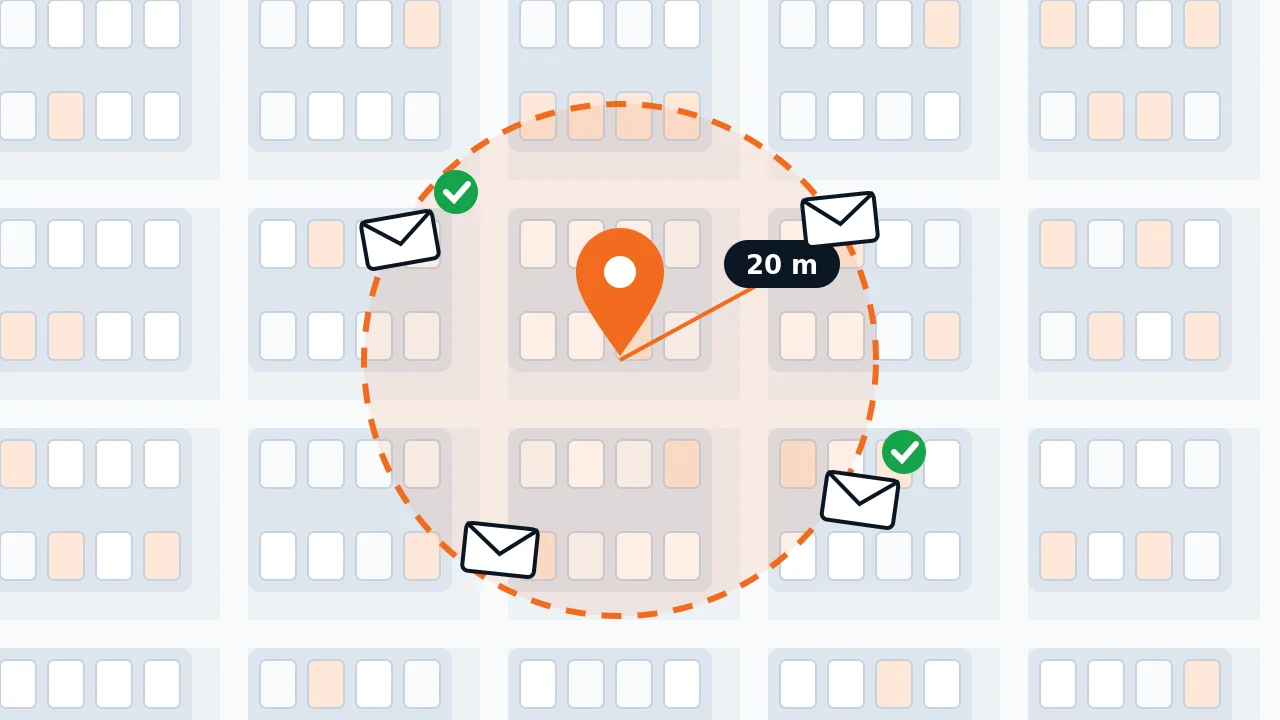
Pin the site, set the radius and get every letterbox inside it as a walk list, with a signed delivery record and printable notices when the job needs them. The count is free.